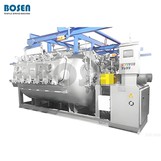
In the textile industry, the liquid flow dyeing machine plays a crucial role in the dyeing process. As a supplier of liquid flow dyeing machines, I have witnessed firsthand the various factors that can influence the dyeing results. One such factor that often goes unnoticed but has a significant impact is the surface smoothness of the fabric. In this blog post, I will delve into the impact of the fabric's surface smoothness on dyeing in a liquid flow dyeing machine.
Understanding the Liquid Flow Dyeing Machine
Before we discuss the impact of fabric surface smoothness, it's essential to understand how a liquid flow dyeing machine works. A High Temperature Liquid Flow Dyeing Machine is designed to circulate the dye liquor through the fabric at a high speed. The fabric is placed in a dyeing chamber, and the dye liquor is pumped through it, allowing the dye to penetrate the fibers. This process is highly efficient and can be used for a wide range of fabrics, including natural and synthetic fibers.
The High Temperature High Pressure Liquid Flow Dyeing Machine takes this process a step further by operating at higher temperatures and pressures. This allows for more rapid and uniform dyeing, especially for fabrics that are more difficult to dye. The Ht Liquid Flow Dyeing Machine is another variant that offers similar benefits, but with a focus on energy efficiency and reduced water consumption.
The Role of Fabric Surface Smoothness
The surface smoothness of a fabric refers to the evenness and texture of its outer layer. A smooth fabric has a uniform surface with minimal irregularities, while a rough fabric has a more uneven surface with bumps and fibers protruding. The surface smoothness of a fabric can have a profound impact on the dyeing process in a liquid flow dyeing machine.
Dye Penetration
One of the primary effects of fabric surface smoothness is on dye penetration. In a liquid flow dyeing machine, the dye liquor needs to penetrate the fabric fibers to achieve a uniform color. A smooth fabric allows the dye liquor to flow more easily over the surface and penetrate the fibers more evenly. This is because there are fewer obstacles for the dye liquor to overcome, and the dye can spread more freely.
On the other hand, a rough fabric can impede the flow of the dye liquor. The irregularities on the surface can create pockets where the dye liquor may not reach, resulting in uneven dyeing. In some cases, the dye may only adhere to the surface of the fabric, rather than penetrating the fibers, leading to a less vibrant and less durable color.
Dye Absorption
The surface smoothness of a fabric also affects its dye absorption capacity. A smooth fabric has a larger surface area available for dye absorption, as the dye liquor can spread more evenly over the surface. This allows the fabric to absorb more dye, resulting in a more intense and saturated color.
In contrast, a rough fabric has a smaller effective surface area for dye absorption. The bumps and fibers on the surface can reduce the contact between the fabric and the dye liquor, limiting the amount of dye that can be absorbed. This can lead to a lighter and less vivid color.
Dye Distribution
Another important aspect of the dyeing process is the distribution of the dye within the fabric. A smooth fabric promotes more uniform dye distribution, as the dye liquor can flow freely through the fabric and reach all areas. This results in a consistent color throughout the fabric.
A rough fabric, however, can cause uneven dye distribution. The irregularities on the surface can create areas where the dye accumulates, while other areas may receive less dye. This can lead to color variations and streaks in the dyed fabric.
Factors Affecting Fabric Surface Smoothness
Several factors can affect the surface smoothness of a fabric, including the type of fiber, the weaving or knitting process, and the finishing treatments.
Fiber Type
Different types of fibers have different surface characteristics. Natural fibers such as cotton and silk tend to have a smoother surface compared to synthetic fibers like polyester and nylon. This is because natural fibers have a more regular and uniform structure, while synthetic fibers may have a more irregular surface due to the manufacturing process.
Weaving or Knitting Process
The way a fabric is woven or knitted can also affect its surface smoothness. A tightly woven or knitted fabric will generally have a smoother surface than a loosely woven or knitted fabric. This is because the tight structure of the fabric reduces the amount of exposed fibers and creates a more even surface.
Finishing Treatments
Finishing treatments such as mercerization, calendaring, and singeing can improve the surface smoothness of a fabric. Mercerization involves treating the fabric with a caustic solution, which can swell the fibers and make the surface smoother. Calendaring is a process of passing the fabric through heated rollers, which can flatten the fibers and create a smooth surface. Singeing is the process of burning off the protruding fibers on the surface of the fabric, resulting in a smoother appearance.
Implications for Dyeing in a Liquid Flow Dyeing Machine
The impact of fabric surface smoothness on dyeing in a liquid flow dyeing machine has several implications for textile manufacturers.
Quality Control
Textile manufacturers need to pay close attention to the surface smoothness of the fabric before dyeing. By ensuring that the fabric has a smooth surface, they can improve the dyeing quality and reduce the risk of uneven dyeing, color variations, and streaks. This can lead to higher customer satisfaction and a better reputation in the market.
Dye Selection
The surface smoothness of the fabric can also influence the choice of dye. For smooth fabrics, dyes that have good penetration and dispersion properties are preferred, as they can achieve a more uniform and intense color. For rough fabrics, dyes that have a higher affinity for the fibers may be more suitable, as they can help to overcome the challenges of uneven dyeing.
Process Optimization
Textile manufacturers can optimize the dyeing process in a liquid flow dyeing machine by adjusting the process parameters based on the surface smoothness of the fabric. For example, for smooth fabrics, the dyeing temperature and time can be reduced, as the dye can penetrate the fibers more easily. For rough fabrics, the dyeing temperature and time may need to be increased to ensure that the dye can penetrate the fibers effectively.
Conclusion
In conclusion, the surface smoothness of the fabric has a significant impact on dyeing in a liquid flow dyeing machine. A smooth fabric promotes better dye penetration, absorption, and distribution, resulting in a more uniform and vibrant color. On the other hand, a rough fabric can cause uneven dyeing, color variations, and streaks. Textile manufacturers need to take into account the surface smoothness of the fabric when dyeing in a liquid flow dyeing machine to ensure high-quality results.
If you are in the textile industry and are looking for a reliable liquid flow dyeing machine supplier, we can offer you a range of high-quality machines that are designed to meet your specific needs. Our High Temperature Liquid Flow Dyeing Machine, High Temperature High Pressure Liquid Flow Dyeing Machine, and Ht Liquid Flow Dyeing Machine are all engineered to provide efficient and effective dyeing solutions. Contact us today to discuss your requirements and explore how our machines can enhance your dyeing process.