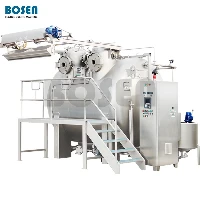
A high-temperature cycle spends most of its heat on the liquor, not on the cloth. A 600 kg load at 1:6 carries 3,600 kg of water that has to be raised to dyeing temperature and then cooled before the machine can be opened. Cutting the water in the circuit cuts the heat, the steam and the cooling water in the same move. That is the mechanism behind the resource figures quoted for this series; the percentages are a consequence of the bath size, not a separate feature.
The HOL Low Energy High Speed Dyeing Equipment holds a 1:5-1:6 ratio and pairs it with a 20 °C/min heat-up and a 15 °C/min cool-down. A smaller thermal mass and a shorter ramp compound over a shift: fewer kilos of water heated per batch, and less idle time between batches.


Where Fuzz Comes From
Fuzz is a mechanical defect rather than a chemical one. It appears wherever cloth slides against a surface while under tension, and it gets worse as speed rises. A liquid-filled guide tube removes the sliding contact; a wave-profiled net reduces whatever contact is left; a relaxed stacked advance keeps the cloth from being pulled hard against anything. BOSEN literature ties this arrangement directly to reduced fuzz formation across the 150-500 m/min band.
Heat-Up And Cool-Down
|
Transition |
Rate |
What It Governs |
|
20 to 130 °C |
20 °C/min |
Time to dyeing temperature and the steam peak that comes with it |
|
130 to 80 °C |
15 °C/min |
Cooling water demand and the wait before unloading |
|
Working ceiling |
140 °C / 4 kg/cm² |
Shell rating carried through the whole cycle |
Rates are given for standard builds. Available steam capacity and cooling water temperature will move the achieved figure on site.
Fuzz Control Measures
|
Measure |
Mechanism |
Effect |
|
Liquid-filled guide tube |
Cloth suspended in liquor, no wall sliding |
No rub marks at running speed |
|
Wave-profiled inner net |
Contact spread over the crests |
Lower abrasion during long runs |
|
Relaxed stacked advance |
Low spray pressure, high liquor volume |
No pilling and no yarn breakage |
|
Tail-end steam setting |
Cloth set before it cools |
Fewer wrinkles fixed into the surface |
What Changes Against The Previous Generation
|
Item |
Change |
Basis |
|
Water, electricity, steam, auxiliaries |
Approx. 30% lower |
BOSEN HOL literature |
|
Chamber capacity |
Approx. 30% higher |
BOSEN HOL literature |
|
Liquor ratio |
1:5 - 1:6 |
BOSEN HOL literature |
Both percentages refer to comparable process conditions against the previous generation of the same platform. They are not additive with each other and should not be read as a guarantee for a specific plant.
Choosing A Chamber Count
Chamber count follows batch size rather than an energy target: one chamber for 300-400 kg, two for 600-800 kg, four for 1200-1600 kg. Because the transport principle does not change with chamber count, the thermal and surface behaviour described here holds across the range. Motor ratings and frame dimensions for each model sit in the model table on the jet flow low liquor ratio page.
Where To Find Dimensions And Defect Guidance
This page covers thermal behaviour and surface condition. For cloth path geometry, defect diagnosis and the full dimensional table, use the fabric guiding page and the model range page for the series.


Hot Tags: low energy high speed dyeing equipment, China low energy high speed dyeing equipment manufacturers, suppliers, Eco Friendly Jet Dyeing Machine, High Temperature High Pressure Jet Dyeing Machine, Ht Jet Dyeing Machine, jet dyeing machine, Low Liquor Ratio Jet Dyeing Machine, Rapid Ht Jet Dyeing Machine