Why Capacity And Surface Quality Pull Apart
On most machines a larger load means more cloth-to-cloth and cloth-to-metal contact, so the biggest batch is also the batch with the most surface risk. The usual compromise is to slow the machine as the load grows. This Dual Path Fabric Guiding Dyeing Machine does not take that compromise: it changes how the cloth is guided so capacity can rise while the contact load stays low.


The Dual Path Arrangement
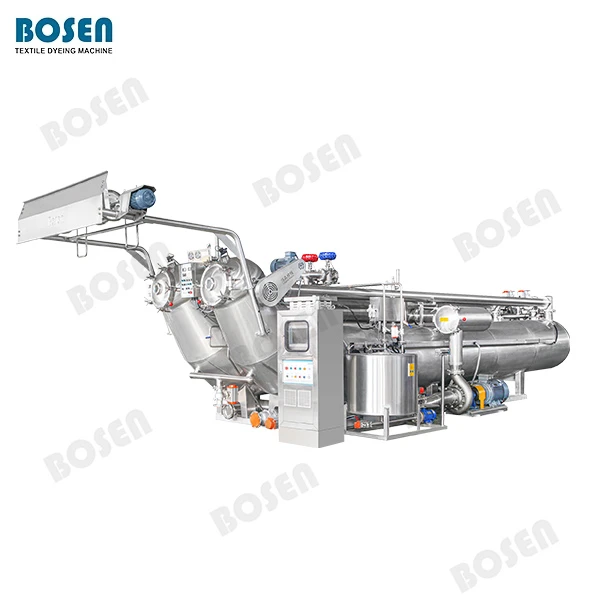
The patented trough and the dual-path guiding structure split thin fabric into two fast-running loops. Each length of cloth covers a shorter distance per circuit, so the friction that would build up over one long loop never accumulates. With a liquid-filled guide tube and a wave-profiled net in the same path, the cloth spends its circuit suspended rather than dragged.
Two loops instead of one heavy rope, so the stack is distributed across the trough.
Liquid-filled tube keeps cloth off the inner wall.
Wave-profiled net spreads whatever contact remains.
Tail-end steam setting holds the surface flat while the cloth cools.
Troubleshooting At The Machine
|
Defect |
Conventional cause |
Response in this design |
|
Fuzz and pilling |
Sliding contact with guide surfaces |
Floating transport in a liquid-filled tube |
|
Yarn breakage, rub marks |
High nozzle force on a stacked rope |
Low spray pressure, high liquor circulation |
|
Rope creases, curled selvedge |
Closed rope-form advance |
N-form path under low tension |
|
Progressive abrasion |
Sustained wall contact |
Wave-profiled inner net |
Products Description
|
Symptom |
Likely cause |
First adjustment |
|
Fuzz on the face of thin cloth |
Cloth running as one long loop at top speed |
Split into two loops, then drop to the middle of the speed band |
|
Crease line along the selvedge |
Cloth advancing in closed rope form |
Check the N-form path, then the tail-end steam setting |
|
Selvedge curling after cool-down |
Cloth held in a crease while cooling |
Extend steam setting before the cool-down step |
|
Shading across the batch |
Circulation frequency low for the load |
Raise liquor circulation rather than nozzle pressure |
|
Yarn breaks in fine counts |
Nozzle force too high for the construction |
Lower spray pressure and rely on liquor volume |
Every item above is an adjustment inside the machine, not a change of platform. The five faults listed account for most surface complaints raised against high-temperature jet machines, and all five are addressed by the same transport principle rather than by separate options.
Cloth Path And Tension
|
Element |
Setting |
Purpose |
|
Cloth path |
N-form |
Opens the rope; stops creases setting in |
|
Tension state |
Low |
Allows high speed without stretching the cloth |
|
Transport |
Liquor volume, not nozzle force |
Protects delicate surfaces |
|
Speed band |
150 - 500 m/min |
Chosen within the band for the construction |
Scaling Capacity Without Changing The Transport
All three chamber counts use the same trough, guide tube and net profile. A dyehouse that starts with a single 300-400 kg chamber and later adds a four-chamber 1200-1600 kg machine gets the same fabric behaviour on both, so a recipe transfers instead of being redeveloped. Dimensions for the larger frames are listed in the model table on the model range page.
Workshop


Hot Tags: dual path fabric guiding dyeing machine, China dual path fabric guiding dyeing machine manufacturers, suppliers, High Temperature Airflow Dyeing Machine, Ht Jet Dyeing Machine, Hthp Jet Dyeing Machine, jet dyeing machine, Low Liquor Ratio Jet Dyeing Machine, Rapid Ht Jet Dyeing Machine